

Hiring is not collapsing. It is stretching. Not dramatically. Not loudly. But consistently. Over the past four years, average time-to-hire across North America has moved from roughly 32 days to a projected 40 days. That is an eight-day increase. A 25 percent rise in decision time.
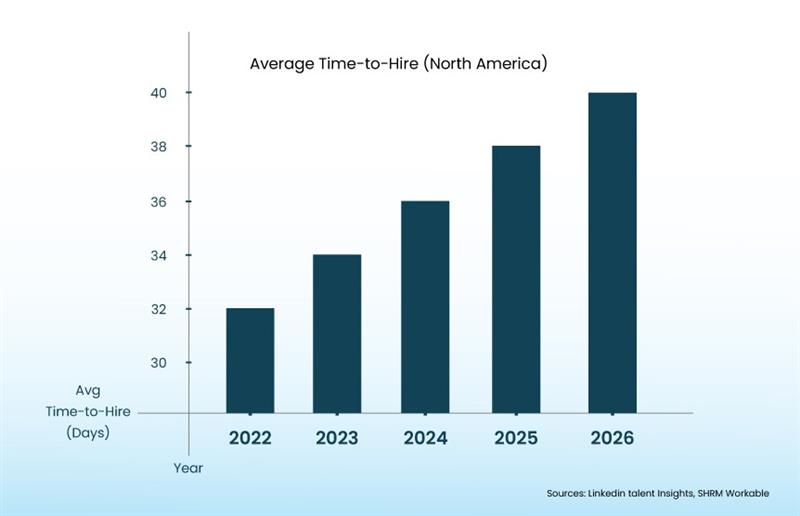
Hiring is not collapsing. It is stretching. Not dramatically. Not loudly. But consistently. Over the past four years, average time-to-hire across North America has moved from roughly 32 days to a projected 40 days. That is an eight-day increase. A 25 percent rise in decision time.
On paper, eight days feels manageable. In practice, eight days compounds into delayed launches, slower transformation projects, overstretched teams, and lost candidate momentum. The question is not whether hiring is slowing. It is. The real question is why.
If Technology Is Faster, Why Is Hiring Slower?
AI screening is sharper. Applicant tracking systems are smarter. Dashboards promise end-to-end visibility. Organizations are investing more than ever in recruitment technology. Yet hiring timelines continue to rise. Because the bottleneck is no longer sourcing. It is decision-making.
Most roles today do not stall because candidates are unavailable. They stall after interviews. Strong profiles are shortlisted. Panels are completed. Assessments are reviewed. And then the process slows. Not because the pipeline is weak, but because internal hesitation begins. Hiring has quietly become a decision architecture problem.
Too Many Stakeholders, No Clear Owner
Modern hiring rarely belongs to one person. Engineering wants technical depth. Product wants strategic alignment. Security wants risk coverage. Finance wants cost validation. Leadership wants long-term impact.
Each perspective matters. But when accountability is diffused, velocity collapses. What should be a 48-hour decision becomes a 10-day alignment cycle. The delay is not in finding talent. It is in agreeing on talent.
The Post-2022 Psychology Shift
After market corrections and cost scrutiny, executive behavior changed. Hiring feels heavier. Every headcount is examined. Every mis-hire feels amplified. So the internal question shifts from “Is this candidate capable?” to “Are we absolutely certain?”
Certainty requires more validation. More comparison. More rounds. The intention is risk control. The outcome is timeline inflation. Perfection extends process. Clarity shortens it.
Role Ambiguity Multiplies Delay
Sometimes the slowdown begins before the first interview. Is this hire strategic or execution-focused? Do we prioritize industry context or technical depth? Is this urgent or exploratory?
When stakeholders are unclear on success criteria, interviews become exploratory instead of decisive. Evaluation criteria shift mid-process. Expectations evolve. Shortlists restart. Not because talent failed, but because alignment did.
Feedback Without Structure
One of the most common contributors to rising time-to-hire is undefined feedback windows. Shortlists are shared. Responses drift. Stakeholders travel. Reviews stretch. Hiring rarely collapses. It dilutes. And that dilution pushes averages from 32 toward 40 days.
Candidates Are Moving Faster Than Companies
While organizations have become more cautious, candidates have accelerated. High-demand professionals often manage multiple interview processes simultaneously. If your cycle extends beyond three to four weeks without clear signals, strong candidates disengage. What follows is a restart. Restart cycles inflate metrics more than sourcing ever could. Ironically, extended validation increases risk instead of reducing it.
When 40 Days Becomes a Business Risk
An eight-day increase is not cosmetic. It impacts revenue-generating roles left open longer. It delays product timelines. It strains risk-sensitive functions. It stretches recruiter capacity across prolonged searches. At 40 days, time-to-hire stops being a recruiting KPI. It becomes an operational signal.
Automation Cannot Fix Indecision
AI improves sourcing efficiency. Automation improves resume throughput. Dashboards improve reporting. But technology cannot resolve stakeholder misalignment, undefined ownership, shifting evaluation criteria, or hesitant executive decisions. Technology compresses workflow. It does not compress indecision.
What This Means for 2026
If 40 days becomes the new baseline, organizations face a choice. Continue layering caution onto hiring, or redesign hiring around decision clarity.
The companies that outperform will not simply hire faster. They will define non-negotiables before sourcing begins. Assign one accountable decision owner. Set fixed feedback windows. Align stakeholders upfront. Treat decision velocity as a strategic lever. The difference between 32 days and 40 days is not eight days. It is the difference between momentum and stall.
Time-to-hire is not rising because talent disappeared. It is rising because decisions became heavier. Until organizations reduce the weight of internal alignment, the metric will continue to climb. Hiring is no longer a sourcing problem. It is a clarity problem. And clarity is now a competitive advantage.

Sabah Shakeel
Staff Writer, Digital Marketing Specialist
SRA Group